
|
Size: 2144
Comment:
|
← Revision 31 as of 2013-03-08 10:02:15 ⇥
Size: 7732
Comment: converted to 1.6 markup
|
| Deletions are marked like this. | Additions are marked like this. |
| Line 2: | Line 2: |
The noise covariance matrix is needed for the computation of the inverse operator. |
The noise covariance matrix is needed for the computation of the inverse operator. |
| Line 7: | Line 6: |
| * raw MEG data files (which are used for averaging, after maxfilter) | * raw MEG data files (e.g. those used for averaging, after maxfilter) |
| Line 9: | Line 8: |
| * a description file (see below) | * '''[[#covdescription|a description file]]''' (see below) You can '''[[#visualisecov|visualise the covariance matrices]]''' in Matlab. |
| Line 12: | Line 13: |
Note: For some applications, for example [[http://imaging.mrc-cbu.cam.ac.uk/meg/AnalyzingData/MNE_singletrial|single-trial analysis]], you should use a covariance matrix computed on empty-room data. Pre-processing for these data should be as similar as possible to the raw data files used for analysis. The parameters below are reasonable choices for standard analyses. However, these Wiki pages are not supposed to substitute the [[http://www.nmr.mgh.harvard.edu/meg/manuals/MNE-manual-2.6.pdf|MNE manual]], [[http://imaging.mrc-cbu.cam.ac.uk/meg/MEGpapers|reading papers]], and [[CbuImaging:ImagersInterestGroup|discussions]] with more experienced researchers. |
|
| Line 16: | Line 21: |
| Line 19: | Line 22: |
path='<myrawMEGdatapath>' # where your raw MEG fiff-files are |
datapath='<myrawMEGdatapath>' # root directory for your MEG data |
| Line 28: | Line 29: |
# MEG subdirectories (your directory structure may differ) |
# MEG subdirectories (your directory structure may differ) |
| Line 35: | Line 35: |
| Line 38: | Line 36: |
nsubjects=${#subjects[*]} |
nsubjects=${#subj_pre[*]} |
| Line 41: | Line 38: |
| Line 46: | Line 41: |
| echo " Computing covariance matrix for SUBJECT ${subjects[m]}" | echo " Computing covariance matrix for SUBJECT ${subj_pre[m]}" |
| Line 48: | Line 43: |
| Line 50: | Line 44: |
| --raw ${path}/${subj_pre[m]}/${subj_dir[m]}/rawMEGfile_raw1.fif \ --raw ${path}/${subj_pre[m]}/${subj_dir[m]}/rawMEGfile_raw2.fif \ --raw ${path}/${subj_pre[m]}/${subj_dir[m]}/rawMEGfile_raw3.fif \ --eventsout ${path}/${subj_pre[m]}/${subj_dir[m]}/rawMEGfile_raw1-eve.txt \ --eventsout ${path}/${subj_pre[m]}/${subj_dir[m]}/rawMEGfile_raw2-eve.txt \ --eventsout ${path}/${subj_pre[m]}/${subj_dir[m]}/rawMEGfile_raw3-eve.txt \ --projoff \ --cov cov_desc1.cov \ |
--raw ${datapath}/${subj_pre[m]}/${subj_dir[m]}/rawMEGfile_raw1.fif \ --raw ${datapath}/${subj_pre[m]}/${subj_dir[m]}/rawMEGfile_raw2.fif \ --raw ${datapath}/${subj_pre[m]}/${subj_dir[m]}/rawMEGfile_raw3.fif \ --eventsout ${datapath}/${subj_pre[m]}/${subj_dir[m]}/rawMEGfile_raw1-eve.txt \ --eventsout ${datapath}/${subj_pre[m]}/${subj_dir[m]}/rawMEGfile_raw2-eve.txt \ --eventsout ${datapath}/${subj_pre[m]}/${subj_dir[m]}/rawMEGfile_raw3-eve.txt \ --projon \ --cov cov_desc1.cov \ |
| Line 60: | Line 54: |
| --savecovtag -cov \ --gcov ${path}/${subj_pre[m]}/${subj_dir[m]}/covmat-cov.fif |
--savecovtag -cov \ --gcov ${datapath}/${subj_pre[m]}/${subj_dir[m]}/covmat-cov.fif |
| Line 66: | Line 58: |
| <<Anchor(covdescription)>> | |
| Line 67: | Line 60: |
| where the covariance description files cov_desc?.cov are of the form | == Covariance Matrix Description File == where the '''covariance description files''' cov_desc?.cov are of the form |
| Line 70: | Line 64: |
| cov { gradReject 200e-12 # artefact rejection thresholds magReject 3e-12 eegReject 120e-6 eogReject 150e-6 logfile YourLogFileName.txt # logfile that will contain some useful information fixSkew # Fixes problems with trigger onsets on different bits |
|
| Line 71: | Line 72: |
| cov { gradReject 2000e-13 magReject 3e-12 eegReject 120e-6 eogReject 150e-6 def { event 1 tmin -0.2 tmax 0 basemin -0.2 basemax 0.0 } |
def { event 1 # trigger code tmin -0.2 # interval used for covariance computation tmax 0 basemin -0.2 # interval used for baseline correction basemax 0.0 } def { event 2 tmin -0.2 tmax 0 basemin -0.2 basemax 0.0 } def { event 3 tmin -0.2 tmax 0 basemin -0.2 basemax 0.0 } |
| Line 87: | Line 95: |
| If the parameters are the same for all input files, you only have to specify one description file. For more details and options see the MNE manual. | |
| Line 88: | Line 97: |
| If the parameters are the same for all input files, you only have to specify one description file. For more details and options see the MNE manual. | <<Anchor(visualisecov)>> == Visualise Covariance Matrices == The following script allows you to '''visualise covariance matrices''' for EEG (if used), magnetometers and gradiometers separately: {{{ % Will read MNE covariance matrix files (*.fif) % and visualised them separately for magnetometers, gradiometers and EEG % EEG will be average-referenced % Olaf Hauk, Nov 2010 covpath = '/YourPathToData/'; % root directory for data covname = 'YourFilename.fif'; % filename for MNE covariance matrix files in subject directories % Specify subject information: MEG ID 1, MEG ID2 (may depend on your experiment) % the script will look for covpath/subject{x}{1}/subject{x}{2}/covname as covariance matrix cnt = 1; subject{cnt} = {'meg10_0005', '123456'}; cnt = cnt+1; subject{cnt} = {'meg10_0006', '654321'}; cnt = cnt+1; subject{cnt} = {'meg10_0007', '162534'}; cnt = cnt+1; nr_subs = length(subject); % number of subjects specified for ss = 1:nr_subs, % for all subjects... filein = fullfile( covpath, subject{ss}{1}, subject{ss}{2}, covname ); % input filename of covariance matrix file fprintf(1, '\nReading covariance matrix from %s\n', filein); covmat = mne_read_noise_cov( filein ) % read noise covariance matrix using MNE Matlab tool channames = covmat.names; % names of channels indices_EEG = strmatch('EEG', channames); % indices for EEG channels indices_MEG = strmatch('MEG', channames); % indices for MEG channels (grads+mags) for i=1:length(indices_MEG), lastnum(i) = str2num( channames{indices_MEG(i)}(end) ); % get last number of MEG channel names end; % i indices_mags = indices_MEG( find ( lastnum == 1 ) ); % find magnetometer indices indices_grads = indices_MEG( find ( (lastnum==2)+(lastnum==3) ) ); % find gradiometer indices fprintf(1, 'There are %d magnetometers and %d gradiometers.\n', length(indices_mags), length(indices_grads)); figure; % create new figure if ~isempty(indices_EEG), % if file contains EEG... nr_EEG = length(indices_EEG); % number of electrodes fprintf(1, '...oh, and %d EEG electrodes.\n Average referencing EEG.\n\n', nr_EEG); covmatEEG = covmat.data(indices_EEG, indices_EEG); % separate EEG covariance matrix avgop = eye(nr_EEG) - ones(nr_EEG)/nr_EEG; % average reference operator covmatEEG = avgop*covmatEEG*avgop; % apply average reference to EEG covariance matrix nr_plots = 3; % plot mags, grads and EEG subplot(1,nr_plots,1); imagesc( covmatEEG ); axis( 'square' ); colorbar; th = title(['EEG ' subject{ss}{1}]); set(th, 'Interpreter', 'none'); else, nr_plots = 2; end; % plot mags and grads (no EEG) covmatmag = covmat.data(indices_mags, indices_mags); % separate mags covariance matrix subplot(1,nr_plots,2); imagesc( covmatmag ); axis( 'square' ); colorbar; th = title(['Mags ' subject{ss}{1}]); set(th, 'Interpreter', 'none'); covmatgrad = covmat.data(indices_grads, indices_grads); % separate grads covariance matrix subplot(1,nr_plots,3); imagesc( covmatgrad ); axis( 'square' ); colorbar; th = title(['Grads ' subject{ss}{1}]); set(th, 'Interpreter', 'none'); end; % ss }}} The result may look something like this: {{attachment:Covariance.jpg}} Note: The patterns in these images are due to the spatial arrangements of electrodes and sensors. They may therefore vary for different sensor configurations. The main thing to look out for are channels with huge covariances, or flat channels, or patterns that suggest that all electrodes measured the same signal (indicating a problem with the reference etc.). The EEG in this example was average-referenced, and the MEG data maxfiltered. |
Computing the Noise Covariance Matrix
The noise covariance matrix is needed for the computation of the inverse operator.
Ingredients for this script are
* raw MEG data files (e.g. those used for averaging, after maxfilter)
* a description file (see below)
You can visualise the covariance matrices in Matlab.
The end result is a fiff-file containing the noise covariance matrix, which can be read into Matlab using mne_read_noise_cov.
Note: For some applications, for example single-trial analysis, you should use a covariance matrix computed on empty-room data. Pre-processing for these data should be as similar as possible to the raw data files used for analysis.
The parameters below are reasonable choices for standard analyses. However, these Wiki pages are not supposed to substitute the MNE manual, reading papers, and discussions with more experienced researchers.
#
## Your variables:
datapath='<myrawMEGdatapath>'    # root directory for your MEG data
# MEG IDs (your directory structure may differ)
subj_pre=(\
        'meg10_0001' \
        'meg10_0002' \
        'meg10_0003' \
        )
# MEG subdirectories (your directory structure may differ)
subj_dir=(\
         '100001' \
         '100002' \
         '100003' \
        )
## Processing:
nsubjects=${#subj_pre[*]}
lastsubj=`expr $nsubjects - 1`
for m in `seq 0 ${lastsubj}`
do
  echo " "
  echo " Computing covariance matrix for SUBJECT  ${subj_pre[m]}"
  echo " "
  mne_process_raw  \
                --raw ${datapath}/${subj_pre[m]}/${subj_dir[m]}/rawMEGfile_raw1.fif \
                --raw ${datapath}/${subj_pre[m]}/${subj_dir[m]}/rawMEGfile_raw2.fif \
                --raw ${datapath}/${subj_pre[m]}/${subj_dir[m]}/rawMEGfile_raw3.fif \
                --eventsout ${datapath}/${subj_pre[m]}/${subj_dir[m]}/rawMEGfile_raw1-eve.txt \
                --eventsout ${datapath}/${subj_pre[m]}/${subj_dir[m]}/rawMEGfile_raw2-eve.txt \
                --eventsout ${datapath}/${subj_pre[m]}/${subj_dir[m]}/rawMEGfile_raw3-eve.txt \
                --projon \
                --cov cov_desc1.cov \
                --cov cov_desc2.cov \
                --cov cov_desc3.cov \
                --savecovtag -cov \
                --gcov ${datapath}/${subj_pre[m]}/${subj_dir[m]}/covmat-cov.fif
done # subjects
Covariance Matrix Description File
where the covariance description files cov_desc?.cov are of the form
cov {
        gradReject      200e-12               # artefact rejection thresholds
        magReject       3e-12
        eegReject       120e-6
        eogReject       150e-6
        logfile         YourLogFileName.txt  # logfile that will contain some useful information
        fixSkew                              # Fixes problems with trigger onsets on different bits

        def {
                event   1        # trigger code
                tmin    -0.2     # interval used for covariance computation
                tmax    0
                basemin -0.2     # interval used for baseline correction
                basemax 0.0
        }
        def {
                event   2
                tmin    -0.2
                tmax    0
                basemin -0.2
                basemax 0.0
        }
        def {
                event   3
                tmin    -0.2
                tmax    0
                basemin -0.2
                basemax 0.0
        }
}
If the parameters are the same for all input files, you only have to specify one description file. For more details and options see the MNE manual.
Visualise Covariance Matrices
The following script allows you to visualise covariance matrices for EEG (if used), magnetometers and gradiometers separately:
% Will read MNE covariance matrix files (*.fif)
% and visualised them separately for magnetometers, gradiometers and EEG
% EEG will be average-referenced
% Olaf Hauk, Nov 2010

covpath = '/YourPathToData/';  % root directory for data
covname = 'YourFilename.fif'; % filename for MNE covariance matrix files in subject directories

% Specify subject information: MEG ID 1, MEG ID2 (may depend on your experiment)
% the script will look for covpath/subject{x}{1}/subject{x}{2}/covname as covariance matrix
cnt = 1;
subject{cnt} = {'meg10_0005', '123456'};
cnt = cnt+1;
subject{cnt} = {'meg10_0006', '654321'};
cnt = cnt+1;
subject{cnt} = {'meg10_0007', '162534'};
cnt = cnt+1;

nr_subs = length(subject);  % number of subjects specified

for ss = 1:nr_subs, % for all subjects...

  filein = fullfile( covpath, subject{ss}{1}, subject{ss}{2}, covname );    % input filename of covariance matrix file
  fprintf(1, '\nReading covariance matrix from %s\n', filein);

  covmat = mne_read_noise_cov( filein )    % read noise covariance matrix using MNE Matlab tool

  channames = covmat.names; % names of channels
  indices_EEG = strmatch('EEG', channames); % indices for EEG channels
  indices_MEG = strmatch('MEG', channames); % indices for MEG channels (grads+mags)
  for i=1:length(indices_MEG),
      lastnum(i) = str2num( channames{indices_MEG(i)}(end) );   % get last number of MEG channel names
  end;  % i

  indices_mags = indices_MEG( find ( lastnum == 1 ) );  % find magnetometer indices
  indices_grads = indices_MEG( find ( (lastnum==2)+(lastnum==3) ) );   % find gradiometer indices

  fprintf(1, 'There are %d magnetometers and %d gradiometers.\n', length(indices_mags), length(indices_grads));

  figure;   % create new figure

  if ~isempty(indices_EEG), % if file contains EEG...
    nr_EEG = length(indices_EEG); % number of electrodes
    fprintf(1, '...oh, and %d EEG electrodes.\n Average referencing EEG.\n\n', nr_EEG);
    covmatEEG = covmat.data(indices_EEG, indices_EEG);  % separate EEG covariance matrix
    avgop = eye(nr_EEG) - ones(nr_EEG)/nr_EEG;  % average reference operator
    covmatEEG = avgop*covmatEEG*avgop;  % apply average reference to EEG covariance matrix
    nr_plots = 3;   % plot mags, grads and EEG
    subplot(1,nr_plots,1);
    imagesc( covmatEEG );
    axis( 'square' );
    colorbar;
    th = title(['EEG ' subject{ss}{1}]); set(th, 'Interpreter', 'none');
  else,
      nr_plots = 2;
  end;  % plot mags and grads (no EEG)

  covmatmag = covmat.data(indices_mags, indices_mags);  % separate mags covariance matrix
  subplot(1,nr_plots,2);
  imagesc( covmatmag );
  axis( 'square' );
  colorbar;
  th = title(['Mags ' subject{ss}{1}]); set(th, 'Interpreter', 'none');

  covmatgrad = covmat.data(indices_grads, indices_grads);  % separate grads covariance matrix
  subplot(1,nr_plots,3);
  imagesc( covmatgrad );
  axis( 'square' );
  colorbar;
  th = title(['Grads ' subject{ss}{1}]); set(th, 'Interpreter', 'none');

end;    % ss
The result may look something like this:
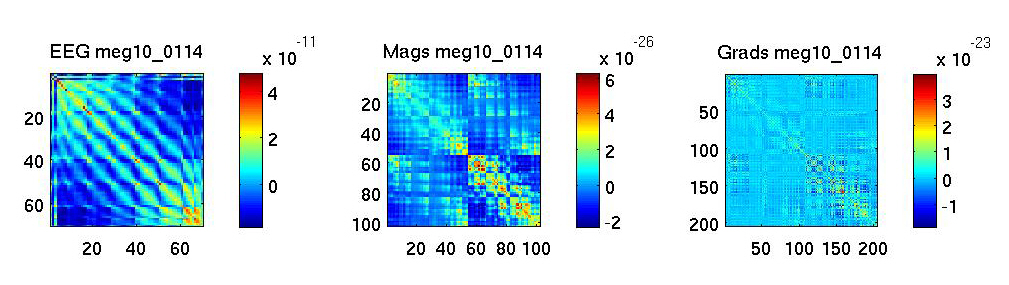
Note: The patterns in these images are due to the spatial arrangements of electrodes and sensors. They may therefore vary for different sensor configurations. The main thing to look out for are channels with huge covariances, or flat channels, or patterns that suggest that all electrodes measured the same signal (indicating a problem with the reference etc.). The EEG in this example was average-referenced, and the MEG data maxfiltered.